Box Office closes 1 hour prior to posted closing time. JUN - AUG 8 p.m. to MIDNIGHT, last entry at 11 p.m. SEPT - MAY: 3 p.m. to 11 p.m., last entry at 10 p.m.
Opening times this week:
Monday
8pm - Midnight
Tuesday
8pm - Midnight
Wednesday
8pm - Midnight
Thursday
8pm - Midnight
Friday
8pm - Midnight
Saturday
8pm - Midnight
Sunday
8pm - Midnight
Box Office closes 1 hour prior to posted closing time. JUN - AUG 8 p.m. to MIDNIGHT, last entry at 11 p.m. SEPT - MAY: 3 p.m. to 11 p.m., last entry at 10 p.m.
Opening times this week:
Monday
8pm - Midnight
Tuesday
8pm - Midnight
Wednesday
8pm - Midnight
Thursday
8pm - Midnight
Friday
8pm - Midnight
Saturday
8pm - Midnight
Sunday
8pm - Midnight
Box Office closes 1 hour prior to posted closing time. JUN - AUG 8 p.m. to MIDNIGHT, last entry at 11 p.m. SEPT - MAY: 3 p.m. to 11 p.m., last entry at 10 p.m.
Opening times this week:
Monday
8pm - Midnight
Tuesday
8pm - Midnight
Wednesday
8pm - Midnight
Thursday
8pm - Midnight
Friday
8pm - Midnight
Saturday
8pm - Midnight
Sunday
8pm - Midnight

The Psychology of Neon: Why Bright Signs Make Us Stop, Look, and Spend

Most people don’t think much about signs or if they do, it’s in passing as they take in the information it’s conveying or snap a picture if it’s especially memorable. But did you know that in the act of looking at a sign, processing what it says, and deciding whether or not to walk toward it, your brain has already made a series of decisions you probably weren’t aware of?

This is why the best signs don’t just provide information, but they capture attention (and use science-backed strategies to do it).

Since the beginning of neon, Las Vegas has been one of the world’s most effective laboratories for understanding how color, light, scale, and motion influence human behavior. Long before digital advertising, social media algorithms, or targeted marketing campaigns, businesses on the Strip were competing for the same thing they are today: a few seconds of someone’s attention.

Let’s look at why neon works, including why bright signs make us want to spend our time, money, and energy at certain spots.

Neon is Unique Enough to Get Your Attention

Imagine walking down a busy street at night.

Your eyes are processing an enormous amount of information at once: people, traffic, buildings, sounds, and movement. In fact, our sensory systems (vision, hearing, touch and more) gather data about the environment at a rate of around 1 billion bits per second.

To avoid becoming overwhelmed, the brain constantly filters out details it considers unimportant. So to break through that filter, businesses have to stand out with something unexpected, such as a flash of light, a bright color, or a moving object (and sometimes, all three!).

Many vintage Las Vegas signs incorporated chasing bulbs, animated arrows, flashing borders, or sequential lighting effects for that reason. Motion naturally attracts attention because our brains are wired to notice changes in our environment.

Bigger Isn’t Always Better, But It Helps

Las Vegas signs became famous for their scale, and for good reason.

When businesses are competing along the same roadway, the farther away a sign can be seen, the more opportunities it has to influence someone’s decision-making.

The iconic Stardust sign, for example, was 188 feet tall and 90 feet wide and featured hundreds of stars and bright red lettering. Kermit Wayne from YESCO designed the sign so drivers could see it when they came in from California.

Large signs like this are effective because they reduce the effort required to notice them.

In psychology, researchers often discuss cognitive load, or the amount of mental effort needed to process information. A clear, highly visible sign demands very little effort from the viewer, which means your brain understands it almost instantly.

Color Creates Expectations

Color is one of the first things people notice about a sign, often before they consciously register words or imagery, and different colors tend to evoke different associations.

Warm colors such as red, orange, and yellow often create a sense of energy and excitement, while cooler colors like blue and green can feel calmer or more refined. Bright pinks and turquoises, like the bright pink of the Debbie Reynolds sign, can communicate playfulness, novelty, or fun.

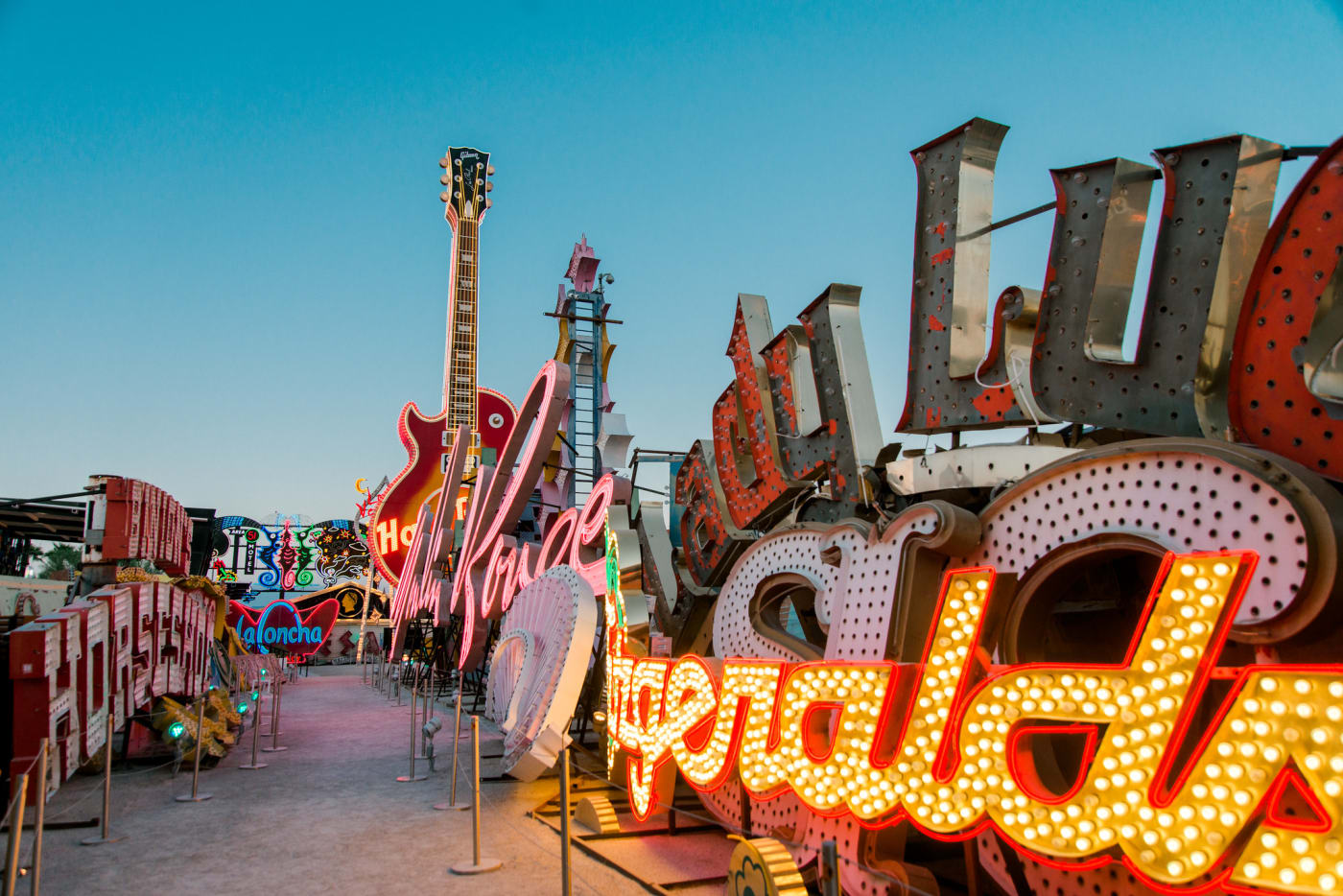
Throughout The Neon Museum’s collection, you’ll find signs that use color strategically to establish a mood before a visitor ever walks through the door. These neon signs created an expectation about the experience waiting inside.

The Glow Matters as Much as the Message

One of neon’s unique characteristics is that it literally radiates color.

Unlike painted surfaces or printed advertisements, neon has a visible glow that extends beyond the lettering itself. At night, that glow can make a sign feel larger, brighter, and more prominent than it actually is, which is one of the reasons why neon was so popular back in the day (and why it’s making a comeback today).

Neon creates a vintage glow that’s easy to see against the night sky, meaning that people notice it faster than other types of signs. It also feels so alive, with its buzzing sound and flowing gases.

Why Some Signs Become Landmarks

Most signs are designed to attract attention, but only a few become memorable decades later. The difference comes down to how distinctive the sign is.

For example, the famous “Welcome to Fabulous Las Vegas” sign is easy to recognize because it doesn’t look like anything else. Likewise, Stardust’s atomic-age typography was unmistakable and the giant cowboy known as Vegas Vic on Fremont Street became memorable because he transformed a simple sign into a character.

Psychologists sometimes refer to this as the “von Restorff effect,” or the tendency for people to remember things that stand out from their surroundings.

Whether you’re looking at a roadside motel sign from the 1950s or a modern logo from today, the signs that survive in our memories are usually the ones that feel different.

Getting People Through the Door

Of course, attracting attention is great but what really matters is getting people through the door.

Las Vegas businesses understand that a sign is often the first interaction a customer has with a property. Long before guests experience the casino floor, the shows, or the restaurants, they experience the sign.

Because of this, the most famous neon signs served as both advertisements and introductions to the property and the brand. The most successful ones offered a preview of what to expect and hopefully build loyal customers.

Why Neon Still Works

Today, businesses have access to technologies that sign designers of the 1950s could never have imagined. Massive LED displays, digital billboards, projection mapping, and animated screens can display almost unlimited content.

Yet many of the underlying principles remain the same and in fact, neon is having a bit of a comeback. We are still drawn to contrast, movement, and unique designs no matter how the sign is made. The tools may be different, but the psychology remains remarkably similar.

These unchanging principles are part of what makes vintage neon signs so fascinating. Looking back, we can see how sign designers used the technology they had at the time, which had a lot more limitations than LED or other more modern technologies, to create some of the most memorable visual landmarks in American history.

Using little more than glass tubes, color, scale, and light, neon signs accomplished what they set out to do (and then some). If you’re interested in learning more about neon and the history behind some of Las Vegas’ most iconic signs, visit The Neon Museum today!

SOURCES