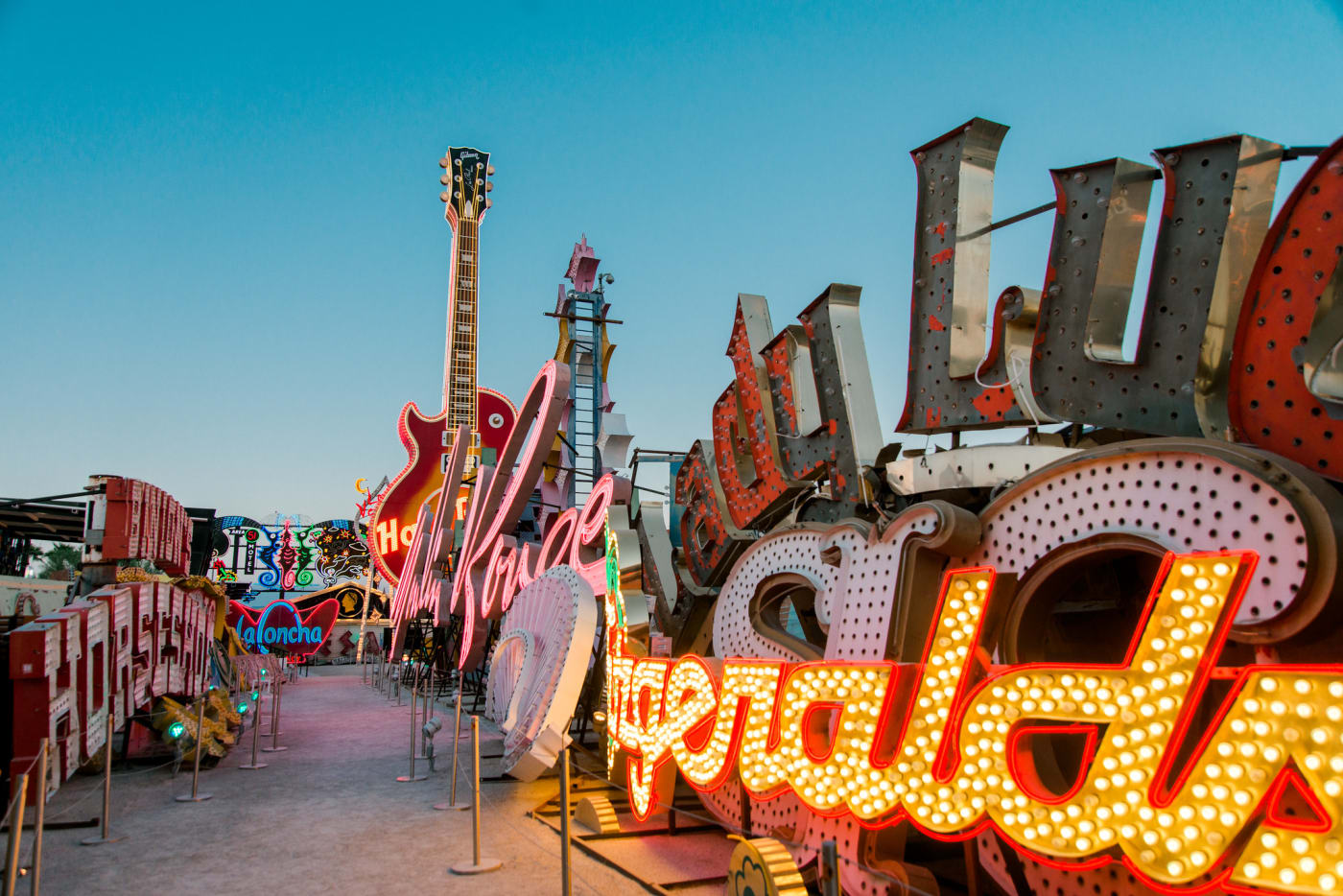
Did you know that while they may look super modern and cutting edge, many of today’s LED signs actually borrow concepts from vintage neon? At The Neon Museum Las Vegas, preserved vintage signs reveal how earlier designers experimented with color, animation, and bold shapes long before LED technology existed. These historic signs helped establish some of the visual conventions that you see on modern digital displays today.
Let’s look at some of the design features that today’s LED signs borrowed from vintage neon signs!
Bright Color Palettes
One of neon’s greatest strengths was its vibrant color range. By combining different gases and colored glass tubing, sign makers could produce intense reds, blues, greens, and yellows that remained highly visible at night.
These bold color palettes became a defining feature of Las Vegas signage. For example, casinos used contrasting colors to make their properties stand out along busy streets, creating a visual competition for attention.
Many modern LED signs follow the same principle. Digital displays often replicate the high-contrast color combinations that neon popularized because they’re still good at attracting the eye on the crowded Strip. Even though the technology has changed, the design logic (bright colors that command attention) remains the same.
The visual identity of Las Vegas itself was shaped by these bright palettes, many of which can still be seen in restored or preserved pieces in The Neon Museum’s collection.
Motion and Animation
Long before digital screens existed, sign designers were already experimenting with motion. Neon and incandescent bulbs could be wired in sequences that turned on and off rapidly, creating the illusion of movement.
Common animated effects included:
- Chasing lights, where bulbs illuminate in sequence to simulate motion
- Blinking patterns that create rhythmic flashing
- Starburst effects that radiate outward from a central point
These techniques helped transform static signs into dynamic visual attractions. The famous Stardust sign, for example, featured hundreds of incandescent bulbs arranged in a sparkling cosmic pattern that appeared to shimmer across the sign.
Today’s LED displays achieve movement through programmable pixels and digital animation, but the idea of using motion to draw attention began with these earlier neon techniques. Movement captures the human eye more effectively than static imagery, which is why even the earliest neon signs experimented with this effect.
Bold Typography and Oversized Shapes
Another hallmark of vintage neon signage was the use of large, expressive lettering. Designers often stretched words vertically or horizontally to create dramatic silhouettes that could be seen from far away. The original Flamingo sign is a great example of this, with its sweeping script and bright pink lettering.
This approach was closely tied to mid-century architectural styles such as Googie design, which emphasized exaggerated forms, sweeping lines, and dramatic angles. The goal was to create signage that could be recognized instantly by drivers approaching at night.
Modern LED displays still rely on these same typographic principles. Large lettering, clear shapes, and bold outlines remain essential for readability at a distance. Digital billboards and casino marquees often mimic the scale and visual hierarchy pioneered by neon sign designers decades earlier.
Layered Visual Storytelling
Many historic neon signs combined several design elements into a single sign. These layered designs might feature things like an arrow pointing toward the entrance, decorative shapes such as stars or diamonds, and animated lights surrounding the main lettering.
These layered designs allowed signs to communicate multiple messages at once, directing people where to go and why. The result was neon signs that functioned both as advertising and as architectural art.
Modern LED signage often uses the same layered approach. Even when the display is digital, designers still combine text, motion graphics, and decorative effects to guide viewers’ attention through the message.
The Difference Between Vintage Neon and Modern LED Signs in Terms of Craftsmanship
One of the most significant differences between vintage neon and modern LED signage is how each is made.
Neon signs are crafted by hand as skilled artisans heat and bend glass tubes into precise shapes, carefully forming each letter or design element. These tubes are then filled with noble gases, mainly neon or argon, which emit light when electrified. The process requires a high level of precision, experience, and artistry, as even small inconsistencies in shaping or spacing can affect how the final sign appears.
This handcrafted approach meant that no two neon signs are exactly alike. Subtle variations in curvature, brightness, and construction gives each piece a distinct character. At The Neon Museum, many signs in the collection still reflect these individual qualities, revealing the human touch behind their creation.
In contrast, modern LED signs are typically manufactured using standardized components. Light-emitting diodes are arranged in modules or strips and controlled through software, allowing designers to program color changes, animation, and brightness with precision. While this enables a level of flexibility and efficiency that neon could never achieve, it also shifts the craftsmanship from physical fabrication to digital design.
Rather than bending glass, today’s sign makers are often working with code, layout software, and electronic systems. The artistry still exists, but it’s focused less on manual construction and more on programming and visual composition.
Neon’s Impact Lives On
Although LED technology has largely replaced neon in new construction, the visual language developed during the neon era continues to influence how signs are designed today. Color contrast, motion effects, dramatic lettering, and layered designs all emerged from decades of experimentation with neon tubing and incandescent bulbs.
At The Neon Museum, we help preserve these historic designs so that visitors can see how earlier generations of sign makers shaped the visual identity of Las Vegas. We love celebrating the past, present, and future of neon.

The Neon Museum to Illuminate Inaugural Formula 1 Heineken Silver Las Vegas Grand Prix 2023 Sign to Close Out Duck Duck Shed 2026, Oct. 26

